Rise of Xenophobia and Posthumanphobia
ASX-14-009 · Part I · Interstellar Spirituality · Chapter 4: The Transplanetary Stage
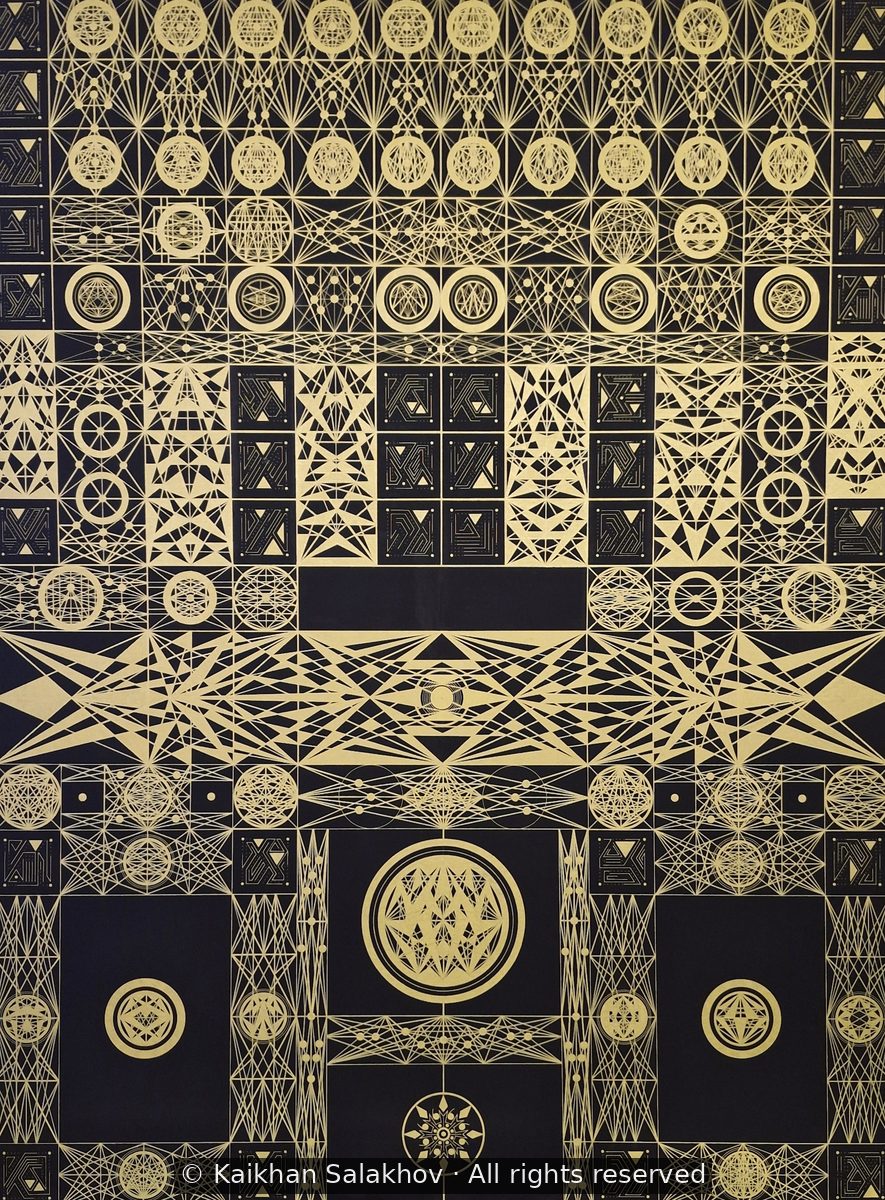
Spirituality Across Life Forms
Comparison of meaning, belief and continuity across different embodiments, cognitive architectures and cultural conditions.
Read the full painting meaning →This discussion examines xenocultural interpretation. Unfamiliar cognition and social organization can make human categories unreliable guides to another population. Its surrounding discussion also concerns intergroup conflict: competing objectives and unequal capabilities can turn disagreement into coercion or organized violence.
The analytical issue is how these conditions affect group membership, social differentiation, cohesion, and the distribution of roles. The node treats the potential dysfunction as an open problem: its identification does not demonstrate that the anticipated outcome will occur or that an assumed technology is feasible.
Main problem
Unfamiliar cognition and social organization can make human categories unreliable guides to another population.
Central question
How could contact procedures distinguish genuine understanding from projection of human assumptions?
Analytical connections
Social Structure
For this xenocultural interpretation problem, social structure examines group membership, social differentiation, cohesion, and the distribution of roles.
Original source prose and question wording remain in the book. The summary and central question are analytical restatements; the author’s complete wording remains in the cited source.
ASX positions and scientific context
- P4 scope
- C position: not established
- Speculative scenario
Physical scope and coordination themes describe fields of inquiry. They do not establish a measured capability or scientific validation.
Cross-domain dependencies
Conditional analytical comparisons; question-level access follows the parent discussion.
Embodiment, identity and recognition
Changes in embodiment, cognition or reproduction can challenge categories of identity and agency. Recognition rules and cultural expectations can then constrain access to enhancement, membership and protection. Unfamiliarity alone is not evidence of lesser moral status.
ASX-14-009: Rise of Xenophobia and Posthumanphobia, pp. 40–40; ASX-34-007: Experiments Comparing Post-Human Species, pp. 255–256.
Open ASX-34-007Embodiment, identity and recognition
Changes in embodiment, cognition or reproduction can challenge categories of identity and agency. Recognition rules and cultural expectations can then constrain access to enhancement, membership and protection. Unfamiliarity alone is not evidence of lesser moral status.
ASX-14-009: Rise of Xenophobia and Posthumanphobia, pp. 40–40; ASX-44-002: Complex Interstellar Construction Projects Designing for the Vacuum: Human Colonization and Expansion of Post-Human Civilization. Forging into the Farthest Reaches of the Galaxy, pp. 328–329.
Open ASX-44-002Embodiment, identity and recognition
Changes in embodiment, cognition or reproduction can challenge categories of identity and agency. Recognition rules and cultural expectations can then constrain access to enhancement, membership and protection. Unfamiliarity alone is not evidence of lesser moral status.
ASX-14-009: Rise of Xenophobia and Posthumanphobia, pp. 40–40; ASX-44-014: Genomic and Cybernetic Experiments on Living Beings. The Ethics of Post-Human Evolution, pp. 335–337.
Open ASX-44-014Embodiment, identity and recognition
Changes in embodiment, cognition or reproduction can challenge categories of identity and agency. Recognition rules and cultural expectations can then constrain access to enhancement, membership and protection. Unfamiliarity alone is not evidence of lesser moral status.
ASX-14-009: Rise of Xenophobia and Posthumanphobia, pp. 40–40; ASX-64-004: Seeding, Breeding and Genetic Engineering in the Light of the Transplanetary Ethical Complexities, Cultural Consequences, pp. 598–601.
Open ASX-64-004Embodiment, identity and recognition
Changes in embodiment, cognition or reproduction can challenge categories of identity and agency. Recognition rules and cultural expectations can then constrain access to enhancement, membership and protection. Unfamiliarity alone is not evidence of lesser moral status.
ASX-14-009: Rise of Xenophobia and Posthumanphobia, pp. 40–40; ASX-64-006: Species-Wide Biological Composition. Recognizing Diversity and Its Significance in a Galactic Civilization, pp. 603–605.
Open ASX-64-006Embodiment, identity and recognition
Changes in embodiment, cognition or reproduction can challenge categories of identity and agency. Recognition rules and cultural expectations can then constrain access to enhancement, membership and protection. Unfamiliarity alone is not evidence of lesser moral status.
ASX-14-009: Rise of Xenophobia and Posthumanphobia, pp. 40–40; ASX-64-009: Neural Diversity and Interspecies Relations. Understanding Brain Structure and Consciousness Throughout Galactic Civilizations, pp. 609–611.
Open ASX-64-009Embodiment, identity and recognition
Changes in embodiment, cognition or reproduction can challenge categories of identity and agency. Recognition rules and cultural expectations can then constrain access to enhancement, membership and protection. Unfamiliarity alone is not evidence of lesser moral status.
ASX-14-009: Rise of Xenophobia and Posthumanphobia, pp. 40–40; ASX-74-006: The Emergence of Synthetic Life-Forms. The Transhumanist Memes, Bioengineering and Unintended Consequences of Creation in the Transplanetary Stage, pp. 725–727.
Open ASX-74-006Exclusion, segregation and conflict
Exclusionary classifications or doctrines can legitimate segregation and coercion. Conflict and coercive governance can in turn intensify mistrust and separation. These are conditional feedback mechanisms, not inevitable consequences of cultural difference.
ASX-14-009: Rise of Xenophobia and Posthumanphobia, pp. 40–40; ASX-34-008: The Rise of Transplanetary Digital Ghettos, pp. 256–258.
Open ASX-34-008Associated paintings
- Astral Space Exploration: The Cosmic Ascension
- Astral Space Exploration: The Creating is the Nature of Cosmos
- Astral Space Exploration: The Cosmic Consciousness
- Astral Space Exploration: The Cosmic Council
- Astral Space Exploration: Cosmic Order
- Astral Space Exploration: The Dreams of Prophecy
- Astral Space Exploration: The Key of Kosmopolis
- Astral Space Exploration: The Holy Supernova
- Spirituality Across Life Forms
- Beyond Species-Centric Classification
- Ethics Across Life Forms
Source organization
- chapter context: CTX-14
Citation
Kaikhan Salakhov (2024). Astral Space Exploration: The Cosmic Renaissance: The Fundamental Principles of Cosmocybernetics. Part I, “Astral Space Exploration Grid: Interstellar Spirituality Through Stages of Development”; Chapter 4, “The Transplanetary Stage”; discussion: “Rise of Xenophobia and Posthumanphobia”, p. 40. Page references follow the supplied 852-page edition; pagination in other editions may differ. Library reference: ASX-14-009. https://www.asxgrid.app/library/records/ASX-14-009.html
Page references follow the supplied 852-page edition; pagination in other editions may differ..
Book publication: . Map created: . Map revised: .