Interstellar Agreements and Cosmic Laws. Mediating Divergent Approaches / Question 3
ASX-24-004-Q03 · Part II · Interstellar Architecture · Chapter 4: The Transplanetary Stage
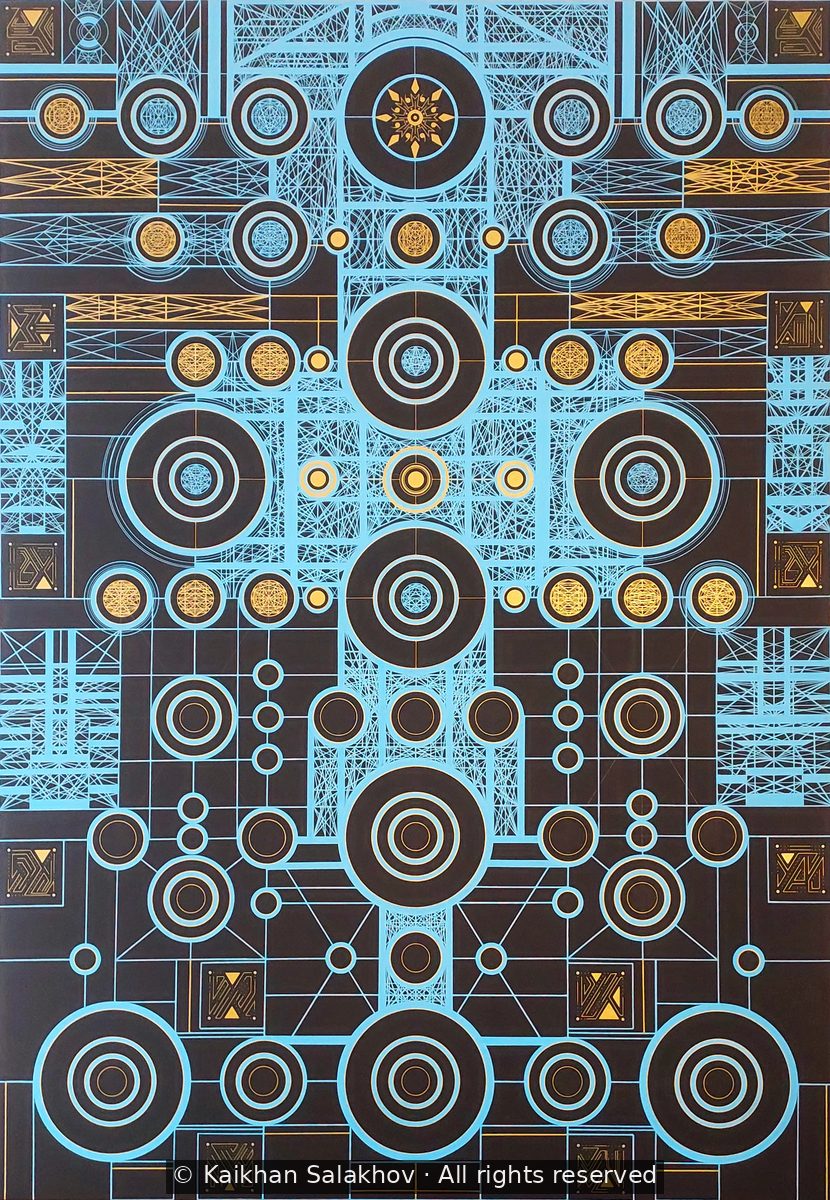
Technologies Across Life Forms
Cooperation, exchange and incompatibility among technical systems shaped by different environments, cognitive architectures and institutions.
Read the full painting meaning →This question examines political authority. The distribution of decision-making power can create conflicts between effective coordination and accountable authority. Its surrounding discussion also concerns conscious experience: the discussion depends on how experience is attributed to beings whose internal states may be inaccessible.
The analytical issue is how these conditions affect decision rights, oversight, institutional responsibility, and mechanisms for challenging authority. The node treats the potential dysfunction as an open problem: its identification does not demonstrate that the anticipated outcome will occur or that an assumed technology is feasible.
Main problem
The distribution of decision-making power can create conflicts between effective coordination and accountable authority.
Central question
How should responsibilities be divided and reviewed so that coordination does not remove public accountability?
Analytical connections
Governance
For this political authority problem, governance examines decision rights, oversight, institutional responsibility, and mechanisms for challenging authority.
Technology
For this political authority problem, technology examines the proposed mechanism, technical dependencies, control interfaces, and failure conditions.
Ethics / Moral Consideration
For this political authority problem, ethics / moral consideration examines consent, exposure to harm, unequal treatment, and the scope of moral protection.
Physical Capability (Reach)
For this political authority problem, physical capability (reach) examines the spatial boundary of operations, dependence between locations, and delays affecting intervention.
Consciousness / Psychology
For this political authority problem, consciousness / psychology examines subjective experience, identity, agency, and the psychological effects of the scenario.
Environmental Systems
For this political authority problem, environmental systems examines environmental dependencies, unintended ecological effects, and conditions required for habitation.
Resource Allocation / Economy
For this political authority problem, resource allocation / economy examines ownership, access to scarce inputs, dependency, and incentives affecting allocation.
Original source prose and question wording remain in the book. The summary and central question are analytical restatements; the author’s complete wording remains in the cited source.
ASX positions and scientific context
- P4 scope
- P5 scope
- C4 thematic relevance
- C position: not established
- Speculative scenario
Physical scope and coordination themes describe fields of inquiry. They do not establish a measured capability or scientific validation.
Cross-domain dependencies
Conditional analytical comparisons; question-level access follows the parent discussion.
Deception and information integrity / Ecological intervention and habitation / Knowledge and cultural continuity / Resource access and concentration of power / Regulation across heterogeneous systems
Manipulated information can alter trust, resource decisions, collective memory and political legitimacy. The links compare this mechanism across domains; quantum or photonic deception retains the scientific limitations of the cited scenario.
Habitats and life-support systems depend on environmental conditions; engineering and resource extraction can change those conditions. Institutional priorities determine acceptable interventions, whose consequences can then alter settlement viability and social choices.
Continuity depends on storage, interpretation, education and communication. Changes to those systems can alter shared knowledge, while communities and institutions decide which records and practices are preserved or excluded.
Unequal access to energy, technology, transport or information can create dependence and unequal bargaining power. Institutions and dominant operators may reinforce or reduce the same inequalities through allocation and access rules.
Different legal and regulatory assumptions can obstruct cooperation, maintenance, migration or technology exchange. The comparison concerns compatibility of authority and obligations, not proof that one legal design is universally appropriate.
ASX-24-004: Interstellar Agreements and Cosmic Laws. Mediating Divergent Approaches, pp. 125–126; ASX-44-018: Corporate Domination and the Controlled Star System/ New Transplanetary Order, pp. 339–340.
Open ASX-44-018Ecological intervention and habitation / Knowledge and cultural continuity / Resource access and concentration of power / Regulation across heterogeneous systems
Habitats and life-support systems depend on environmental conditions; engineering and resource extraction can change those conditions. Institutional priorities determine acceptable interventions, whose consequences can then alter settlement viability and social choices.
Continuity depends on storage, interpretation, education and communication. Changes to those systems can alter shared knowledge, while communities and institutions decide which records and practices are preserved or excluded.
Unequal access to energy, technology, transport or information can create dependence and unequal bargaining power. Institutions and dominant operators may reinforce or reduce the same inequalities through allocation and access rules.
Different legal and regulatory assumptions can obstruct cooperation, maintenance, migration or technology exchange. The comparison concerns compatibility of authority and obligations, not proof that one legal design is universally appropriate.
ASX-24-004: Interstellar Agreements and Cosmic Laws. Mediating Divergent Approaches, pp. 125–126; ASX-64-005: Human Problems and Opportunities of Hybrid Life Forms and Societies within Galactic Civilization. A Xenoanthropological Perspective, pp. 601–603.
Open ASX-64-005Deception and information integrity / Ecological intervention and habitation / Knowledge and cultural continuity / Resource access and concentration of power / Regulation across heterogeneous systems
Manipulated information can alter trust, resource decisions, collective memory and political legitimacy. The links compare this mechanism across domains; quantum or photonic deception retains the scientific limitations of the cited scenario.
Habitats and life-support systems depend on environmental conditions; engineering and resource extraction can change those conditions. Institutional priorities determine acceptable interventions, whose consequences can then alter settlement viability and social choices.
Continuity depends on storage, interpretation, education and communication. Changes to those systems can alter shared knowledge, while communities and institutions decide which records and practices are preserved or excluded.
Unequal access to energy, technology, transport or information can create dependence and unequal bargaining power. Institutions and dominant operators may reinforce or reduce the same inequalities through allocation and access rules.
Different legal and regulatory assumptions can obstruct cooperation, maintenance, migration or technology exchange. The comparison concerns compatibility of authority and obligations, not proof that one legal design is universally appropriate.
ASX-24-004: Interstellar Agreements and Cosmic Laws. Mediating Divergent Approaches, pp. 125–126; ASX-54-004: Cosmic Diversity. The Development of Civilization within the Wilber-Combs Lattice, pp. 473–475.
Open ASX-54-004Knowledge and cultural continuity / Resource access and concentration of power
Continuity depends on storage, interpretation, education and communication. Changes to those systems can alter shared knowledge, while communities and institutions decide which records and practices are preserved or excluded.
Unequal access to energy, technology, transport or information can create dependence and unequal bargaining power. Institutions and dominant operators may reinforce or reduce the same inequalities through allocation and access rules.
ASX-24-004: Interstellar Agreements and Cosmic Laws. Mediating Divergent Approaches, pp. 125–126; ASX-34-006: The Gamification of War. The Strategic and Ethical Implications of Simulated Military Conflicts in an Interstellar Civilization, pp. 253–254.
Open ASX-34-006Deception and information integrity / Knowledge and cultural continuity / Resource access and concentration of power / Regulation across heterogeneous systems
Manipulated information can alter trust, resource decisions, collective memory and political legitimacy. The links compare this mechanism across domains; quantum or photonic deception retains the scientific limitations of the cited scenario.
Continuity depends on storage, interpretation, education and communication. Changes to those systems can alter shared knowledge, while communities and institutions decide which records and practices are preserved or excluded.
Unequal access to energy, technology, transport or information can create dependence and unequal bargaining power. Institutions and dominant operators may reinforce or reduce the same inequalities through allocation and access rules.
Different legal and regulatory assumptions can obstruct cooperation, maintenance, migration or technology exchange. The comparison concerns compatibility of authority and obligations, not proof that one legal design is universally appropriate.
ASX-24-004: Interstellar Agreements and Cosmic Laws. Mediating Divergent Approaches, pp. 125–126; ASX-34-008: The Rise of Transplanetary Digital Ghettos, pp. 256–258.
Open ASX-34-008Deception and information integrity / Ecological intervention and habitation / Knowledge and cultural continuity / Resource access and concentration of power / Regulation across heterogeneous systems
Manipulated information can alter trust, resource decisions, collective memory and political legitimacy. The links compare this mechanism across domains; quantum or photonic deception retains the scientific limitations of the cited scenario.
Habitats and life-support systems depend on environmental conditions; engineering and resource extraction can change those conditions. Institutional priorities determine acceptable interventions, whose consequences can then alter settlement viability and social choices.
Continuity depends on storage, interpretation, education and communication. Changes to those systems can alter shared knowledge, while communities and institutions decide which records and practices are preserved or excluded.
Unequal access to energy, technology, transport or information can create dependence and unequal bargaining power. Institutions and dominant operators may reinforce or reduce the same inequalities through allocation and access rules.
Different legal and regulatory assumptions can obstruct cooperation, maintenance, migration or technology exchange. The comparison concerns compatibility of authority and obligations, not proof that one legal design is universally appropriate.
ASX-24-004: Interstellar Agreements and Cosmic Laws. Mediating Divergent Approaches, pp. 125–126; ASX-54-005: Diverse Ways of Colonization. How Philosophical, Consciousness, and Technological Diversities Will Shape Interstellar Expansion and Terraforming, pp. 475–478.
Open ASX-54-005Deception and information integrity / Ecological intervention and habitation / Knowledge and cultural continuity / Resource access and concentration of power / Regulation across heterogeneous systems
Manipulated information can alter trust, resource decisions, collective memory and political legitimacy. The links compare this mechanism across domains; quantum or photonic deception retains the scientific limitations of the cited scenario.
Habitats and life-support systems depend on environmental conditions; engineering and resource extraction can change those conditions. Institutional priorities determine acceptable interventions, whose consequences can then alter settlement viability and social choices.
Continuity depends on storage, interpretation, education and communication. Changes to those systems can alter shared knowledge, while communities and institutions decide which records and practices are preserved or excluded.
Unequal access to energy, technology, transport or information can create dependence and unequal bargaining power. Institutions and dominant operators may reinforce or reduce the same inequalities through allocation and access rules.
Different legal and regulatory assumptions can obstruct cooperation, maintenance, migration or technology exchange. The comparison concerns compatibility of authority and obligations, not proof that one legal design is universally appropriate.
ASX-24-004: Interstellar Agreements and Cosmic Laws. Mediating Divergent Approaches, pp. 125–126; ASX-74-001: Cosmogeopolitical Games of the Interstellar Great Powers at the Transplanetary Stage. Play at the Level of Billions of Star Systems, pp. 716–718.
Open ASX-74-001Deception and information integrity / Ecological intervention and habitation / Knowledge and cultural continuity / Resource access and concentration of power / Regulation across heterogeneous systems
Manipulated information can alter trust, resource decisions, collective memory and political legitimacy. The links compare this mechanism across domains; quantum or photonic deception retains the scientific limitations of the cited scenario.
Habitats and life-support systems depend on environmental conditions; engineering and resource extraction can change those conditions. Institutional priorities determine acceptable interventions, whose consequences can then alter settlement viability and social choices.
Continuity depends on storage, interpretation, education and communication. Changes to those systems can alter shared knowledge, while communities and institutions decide which records and practices are preserved or excluded.
Unequal access to energy, technology, transport or information can create dependence and unequal bargaining power. Institutions and dominant operators may reinforce or reduce the same inequalities through allocation and access rules.
Different legal and regulatory assumptions can obstruct cooperation, maintenance, migration or technology exchange. The comparison concerns compatibility of authority and obligations, not proof that one legal design is universally appropriate.
ASX-24-004: Interstellar Agreements and Cosmic Laws. Mediating Divergent Approaches, pp. 125–126; ASX-74-004: From Dyson Spheres to Quantum Repeaters, the Interstellar Shadow Games of Power- Manipulation, Control, and Even Sabotage, pp. 722–723.
Open ASX-74-004Deception and information integrity / Ecological intervention and habitation / Knowledge and cultural continuity / Regulation across heterogeneous systems
Manipulated information can alter trust, resource decisions, collective memory and political legitimacy. The links compare this mechanism across domains; quantum or photonic deception retains the scientific limitations of the cited scenario.
Habitats and life-support systems depend on environmental conditions; engineering and resource extraction can change those conditions. Institutional priorities determine acceptable interventions, whose consequences can then alter settlement viability and social choices.
Continuity depends on storage, interpretation, education and communication. Changes to those systems can alter shared knowledge, while communities and institutions decide which records and practices are preserved or excluded.
Different legal and regulatory assumptions can obstruct cooperation, maintenance, migration or technology exchange. The comparison concerns compatibility of authority and obligations, not proof that one legal design is universally appropriate.
ASX-24-004: Interstellar Agreements and Cosmic Laws. Mediating Divergent Approaches, pp. 125–126; ASX-64-011: Mastering Consciousness and Psychological Complexity during Long-Duration Space Flight. Advanced Strategies for Human and Non-Human Societies, pp. 613–616.
Open ASX-64-011Deception and information integrity / Knowledge and cultural continuity / Resource access and concentration of power / Regulation across heterogeneous systems
Manipulated information can alter trust, resource decisions, collective memory and political legitimacy. The links compare this mechanism across domains; quantum or photonic deception retains the scientific limitations of the cited scenario.
Continuity depends on storage, interpretation, education and communication. Changes to those systems can alter shared knowledge, while communities and institutions decide which records and practices are preserved or excluded.
Unequal access to energy, technology, transport or information can create dependence and unequal bargaining power. Institutions and dominant operators may reinforce or reduce the same inequalities through allocation and access rules.
Different legal and regulatory assumptions can obstruct cooperation, maintenance, migration or technology exchange. The comparison concerns compatibility of authority and obligations, not proof that one legal design is universally appropriate.
ASX-24-004: Interstellar Agreements and Cosmic Laws. Mediating Divergent Approaches, pp. 125–126; ASX-34-003: Maintaining Simulation Integrity using Quantum Communication Technologies, pp. 248–250.
Open ASX-34-003Ecological intervention and habitation / Knowledge and cultural continuity / Resource access and concentration of power / Regulation across heterogeneous systems
Habitats and life-support systems depend on environmental conditions; engineering and resource extraction can change those conditions. Institutional priorities determine acceptable interventions, whose consequences can then alter settlement viability and social choices.
Continuity depends on storage, interpretation, education and communication. Changes to those systems can alter shared knowledge, while communities and institutions decide which records and practices are preserved or excluded.
Unequal access to energy, technology, transport or information can create dependence and unequal bargaining power. Institutions and dominant operators may reinforce or reduce the same inequalities through allocation and access rules.
Different legal and regulatory assumptions can obstruct cooperation, maintenance, migration or technology exchange. The comparison concerns compatibility of authority and obligations, not proof that one legal design is universally appropriate.
ASX-24-004: Interstellar Agreements and Cosmic Laws. Mediating Divergent Approaches, pp. 125–126; ASX-64-003: Adaptive Design-Military Technologies in Multispecies Galactic Societies. Balancing Diversity, Functionality, and Ethics, pp. 596–598.
Open ASX-64-003Deception and information integrity / Resource access and concentration of power / Regulation across heterogeneous systems
Manipulated information can alter trust, resource decisions, collective memory and political legitimacy. The links compare this mechanism across domains; quantum or photonic deception retains the scientific limitations of the cited scenario.
Unequal access to energy, technology, transport or information can create dependence and unequal bargaining power. Institutions and dominant operators may reinforce or reduce the same inequalities through allocation and access rules.
Different legal and regulatory assumptions can obstruct cooperation, maintenance, migration or technology exchange. The comparison concerns compatibility of authority and obligations, not proof that one legal design is universally appropriate.
ASX-24-004: Interstellar Agreements and Cosmic Laws. Mediating Divergent Approaches, pp. 125–126; ASX-44-019: Corporate Espionage and Hacking AI in a Competitive Transplanetary Market, pp. 340–342.
Open ASX-44-019Deception and information integrity / Knowledge and cultural continuity
Manipulated information can alter trust, resource decisions, collective memory and political legitimacy. The links compare this mechanism across domains; quantum or photonic deception retains the scientific limitations of the cited scenario.
Continuity depends on storage, interpretation, education and communication. Changes to those systems can alter shared knowledge, while communities and institutions decide which records and practices are preserved or excluded.
ASX-14-006: The Ethical and Spiritual Challenges of the Transplanetary Stage, pp. 39–39; ASX-24-004: Interstellar Agreements and Cosmic Laws. Mediating Divergent Approaches, pp. 125–126.
Open ASX-14-006Knowledge and cultural continuity / Regulation across heterogeneous systems
Continuity depends on storage, interpretation, education and communication. Changes to those systems can alter shared knowledge, while communities and institutions decide which records and practices are preserved or excluded.
Different legal and regulatory assumptions can obstruct cooperation, maintenance, migration or technology exchange. The comparison concerns compatibility of authority and obligations, not proof that one legal design is universally appropriate.
ASX-14-020: The Avoidance of a Dark Future. An Ethical Blueprint for a Unified Civilization, pp. 42–42; ASX-24-004: Interstellar Agreements and Cosmic Laws. Mediating Divergent Approaches, pp. 125–126.
Open ASX-14-020Deception and information integrity / Regulation across heterogeneous systems
Manipulated information can alter trust, resource decisions, collective memory and political legitimacy. The links compare this mechanism across domains; quantum or photonic deception retains the scientific limitations of the cited scenario.
Different legal and regulatory assumptions can obstruct cooperation, maintenance, migration or technology exchange. The comparison concerns compatibility of authority and obligations, not proof that one legal design is universally appropriate.
ASX-24-004: Interstellar Agreements and Cosmic Laws. Mediating Divergent Approaches, pp. 125–126; ASX-44-013: Interstellar Politics and AI Manipulation, pp. 335–335.
Open ASX-44-013Associated paintings
- Astral Space Exploration: Renovatio
- Astral Space Exploration: The Cosmic Engineering. Part I
- Astral Space Exploration: The Cosmic Engineering. Part II
- Astral Space Exploration: The Cosmic Engineering. Part III
- Astral Space Exploration: The Cosmic Engineering. Part IV
- Technologies Across Life Forms
Source organization
- part of: ASX-24-004
Citation
Kaikhan Salakhov (2024). Astral Space Exploration: The Cosmic Renaissance: The Fundamental Principles of Cosmocybernetics. Part II, “Astral Space Exploration Grid: Interstellar Architecture Through Stages of Development”; Chapter 4, “The Transplanetary Stage”; discussion: “Interstellar Agreements and Cosmic Laws. Mediating Divergent Approaches”; question 3, p. 126. Page references follow the supplied 852-page edition; pagination in other editions may differ. Library reference: ASX-24-004-Q03. https://www.asxgrid.app/library/records/ASX-24-004-Q03.html
Page references follow the supplied 852-page edition; pagination in other editions may differ..
Book publication: . Map created: . Map revised: .